नर्तकात्मा - The Self is a Dancer
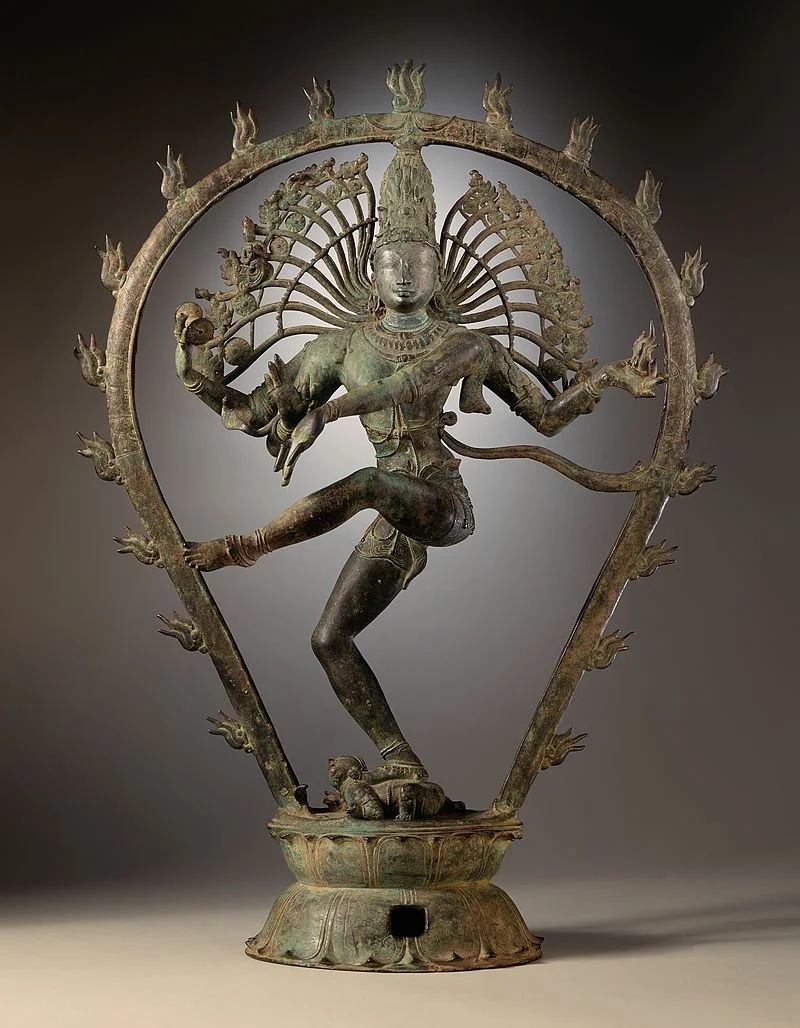
Nartaka ātmā (3.9): “The Self is a Dancer.”
This verse is from the Śiva Sutras, the foundational text of Trika Śaivism that was revealed to the sage Vasugupta in the 9th century CE.
It naturally brings to mind the sublimely magnificent image of Naṭarāja, Śiva as Lord of the Dance, surrounded by the cosmic fire that both creates and destroys, untouched by forces of ignorance and evil, His rhythmic, ecstatic movement the source of time and the universe itself.
But the Self in the Śiva Sutras refers to much more than Naṭarāja, wonderful and evocative as the image is.
The Sanskrit word Naṭ (नट) refers not just to a dancer, but also to an actor in a play.
And the sense of this verse is that the activity of the absolute Self is like the play of an actor in the cosmic drama that is the Universe.
Swami Lakshmanjoo writes:
What is this universal dance? It is everything that you experience in your life. It may be coming. It may be going. It may be birth, death, joy, sadness, depression, happiness, enjoyment. All of this forms part of the universal dance, and this dance is a drama. In this field of drama, the actor is your own nature(172-173).
When an actor plays a role, she conceals who she really is — the actor. Instead, she appears to be the character she is portraying. And when she acts well, the audience does not see her as she really is — the actor — but as the character she is playing. But the actor always knows who she is; she knows that she is not the character, yet the better she is at acting, the more she convinces the audience that she is the character.
But in the case of the universal Self, the actor and the audience are the same, for there is nothing that is not the universal Self. And so the universal Self conceals Itself from Itself, and this concealment is what creates the Universal Drama which It observes, either as the actor who knows it is a drama, or the audience who does not.
And this is what the Śiva Sutras is teaching us: that our true nature is both.
While My Veena Gently Weeps
In his commentary on the Śiva Sutras, Swami Lakshmanjoo writes:
Those who are not aware are not actors; they are played in this drama (172).
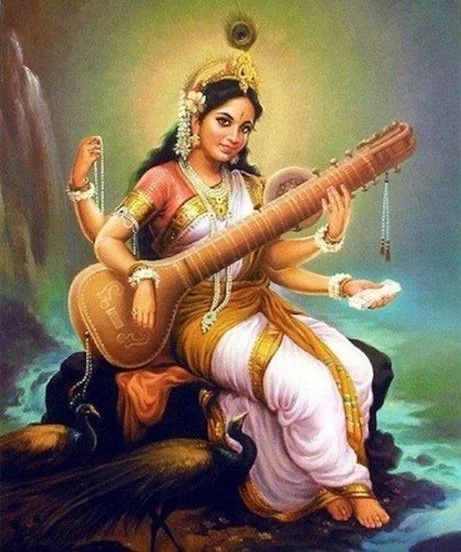
What does this mean, to be “played?” Consider Saraswati, the Goddess of Knowledge, as she sits playing her veena. Does the veena know it is being played? Or consider George Harrison of the Beatles, and his song “While my Guitar Gently Weeps.” It is a beautiful, sad song lamenting the absence of universal love in the world. But ask yourself this question: when George is playing it, is he himself weeping? No, it is not George who is weeping, but his guitar. For if he were truly embodying the sadness of the song, truly deeply feeling it, he could not possibly play it well, for he would be too distraught to do so. It is the played that is sad, not the player. It is the same as the actor who must distinguish himself from the role.
And, as Swami Lakshmanjoo teaches us, it is also the same with the Goddess. Her veena is each one of us when we have not realized who we truly are:
When universal energy, residing in the field of māyā, possesses differentiated and constricted knowledge, she appears to be limited, and thinks such thoughts as, “I am not full,” “I am weak,” “I am stout,” “I am the only fortunate person in the world,” or “I am a great master,” “I have so many disciples,” “I am a world renowned teacher.” By these words, these letters and these objects, she is sometimes filled with grief, sometimes with wonder, sometimes with joy, sometimes with anger, and sometimes with attachment. (50)
This is one reason why in Her iconography the Goddess is so often portrayed as having a fierce form, for that is how She often presents Herself to one who is being played.
The way to end this apparent difficulty is to cease being played and become the player; to realize that you have been, are, and always will be the player all along.
The Playful One
Of course, to most people, this seems quite harsh. It is simply not what they want to believe about God or about the reality in which we find ourselves: not only that there is a God who is good, but that His goodness corresponds to ours. It is the old problem of theodicy: the problem of evil. As William Blake put it in the greatest of all religious poems, as he addresses the horrific existence of the Tyger:
And when the stars threw down their spears, and watered heaven with their tears, Did She smile her work to see? Did She who made the lamb, make thee?
In this regard, the tantric systems are just as uncompromising as was Jehovah in his answer to Job. It simply makes no sense to ascribe good or evil actions to Divinity, because actions are good or evil only insofar as they are done to another, and since (as Nahar was taught by her tutor) the Goddess is fundamentally the Not-Other, there is in reality no other that anything good or bad can be done to, any more than actual good or evil is actually done to one of the characters who appear in a book or play. As Panday puts it in his magisterial work on Abhinavagupta, greatest of the Trika sages:
The reason is that this is a non-dualistic system and, therefore, the so called differently circumstanced individuals have no being apart from Him. And cruelty is cruelty and partiality is partiality only if it be done in relation to another. Therefore, there being no being having a separate being from the Universal Being, the notion of partiality and cruelty being practiced by Him is baseless. Nor can it be questioned: why He manifests this apparent diversity? Because to do so is His essential nature and it is absurd to question it. It is as meaningless as asking why fire burns (442).
And what is true for Śiva is doubly so for His consort, who in the Tripuravidya is named Lalita: She who loves to play. For as Her rule and freedom are infinite, so are Her pleasures unconfined. As E.R.. Eddison has Her put it in his great novels of epic fantasy:
‘Many have blasphemed God for these things,’ she said; ‘but without reason, surely. Shall infinite Love that is able to wield infinite Power be subdued to our necessities? Must the Gods make haste, for Whom no night cometh? Is there a sooner or a later in Eternity? Have you thought of this: you had an evil dream: you were in hell that night; yet you woke and forgot it utterly. Are you tonight any jot the worse for it?’ (loc. 7686)
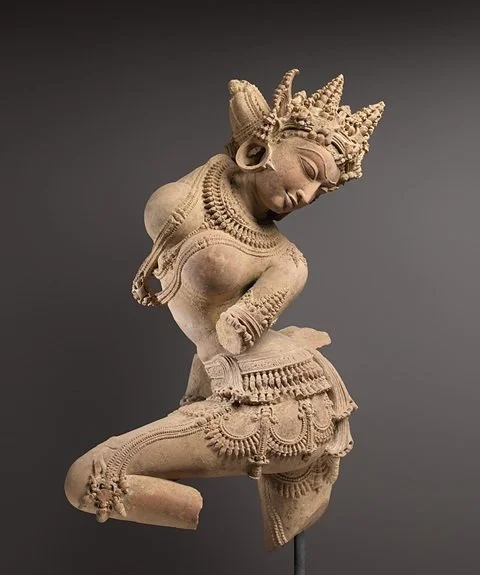
For She is also a dancer, emerging as apsarā, the celestial dancer, in the primordial churning of the milk of immortality, who as Menaka seduced the sage Vishvamitra from his asceticism to give birth to Shakuntala, the mother of Bharata and thus of the Pandava and India herself. And as is written in Nahar:
And the dancing of Nahar before the Krur in the great hall of the palace of Sharab seemed unlike any dancing that had been seen in the world, not since the Goddess Herself danced before the Lord of the Uncreate at the beginning of time, when he followed Her with his eyes as She circled him and the burning of his gaze brought all the worlds into being. (368)
It is for this reason that Tantrikas have been shunned and condemned, and why they are regularly portrayed in Indian popular culture as evil and depraved. For when human beings step outside the boundaries of cultural norms, even in play, they are often denounced and reviled.
Recently in the West, tantric practice has emerged as a way of expressing “sacred sexuality.” This has come about primarily because Christianity in all of its forms is rather hard on sexuality, regarding it - at best - as spiritually neutral, but more often as a necessary evil and often condemning sexual pleasure for its own sake. When Westerners discovered tantric practice during the “sexual revolution” of the sixties, they eagerly seized upon it as a means whereby they could experience sexuality without religious guilt, shame or remorse.
This is salutary as far as it goes, but what most Westerners fail to grasp is that, by definition, a tantric relationship is not a relationship between two human beings but between two Divinities. And, as such, it is a relationship between two who know themselves to be players rather than those who are being played.
This is a principle reason why tantric practice is kept secret (along with the desire to avoid the censure of the orthodox community): the love play of the Goddess and Her Consort is not limited by the boundaries of human conventions, and those who would enter the inner chakras of Their maṇḍala must be well prepared to do so. Sometimes She likes to play rough; and sometimes the pleasures She savors are Dark.
As Doctor Vandermast advised the Great King Mezentius in the novels of Eddison:
‘Your serene highness may yet consider that the greater the power, or the pleasure, the greater needeth to be the discipline.’ The King said, ‘You mean that the Omniscient and Omnipotent must discipline Himself and His own power and His own knowledge, treading, as upon a bridge of two strained ropes above the abysses, at once the way of reason and the way of sensuality?’ Vandermast said, ‘Yes. Within which two ways and their permutations shall be found two million ways wherein a man may live perfectly, or a God. Or two million million ways. Or what more you will. For who shall limit God’s power, or who Her beguiling? (loc. 16563)
Thus, while the Western exploration of tantric sexuality involves moving beyond the imposed limits of Western religion, more advanced practice involves the maintenance of strict limits, although they are self imposed.
Yet in our times such practices gain importance. For surviving our planetary crisis involves firstly and foremostly imagining how we can survive it and, moreover, imagination and fantasy are the means whereby we can rule the immensely powerful impulses of our biological heritage rather than being ruled by them. Dark times may require a descent into darkness, the kind once made long ago by Ishtar, for it is necessary to explore these realms in order to discover the secret of why the Earth Herself is living out, through us, the particular drama and fantasy of a catastrophic collapse of our global civilization, filled with such disharmony and violence.
Notes
Lakshmanjoo, Swami. Shiva Sutras (p. 171). Universal Shaiva Fellowship. Kindle Edition.
Here is a nice version of “While my Guitar Gently Weeps” for you to listen to.
Blake, William. “The Tyger”. Again, I have altered the pronouns to suit my taste.
Nahar gets her lesson in Chapter 35 of Nahar.
“Let him who accuses God answer Him!” (Job 40)
Pandey, Kanti Chandra. Abhinavagupta: An Historical and Philosophical Study. The Chaukhamba Sanskrit Series Vol. I. Chaukhamba Amarabharati Prakashan. Varanasi. 2006. In this passage Pandey references Tantraloka 8.71-72, 82.
Templeton, Kirk. Nahar. Kirk Templeton Books. Kindle Edition.
On of my favorite examples of a villainous Tantrika is the wonderful Amrish Puri in Nagina, where he attempts to subdue a shape-shifting female cobra (played by Sridevi) to his evil will.
Eddison, E. R.. The Complete Zimiamvia. HarperCollins Publishers. Kindle Edition.